
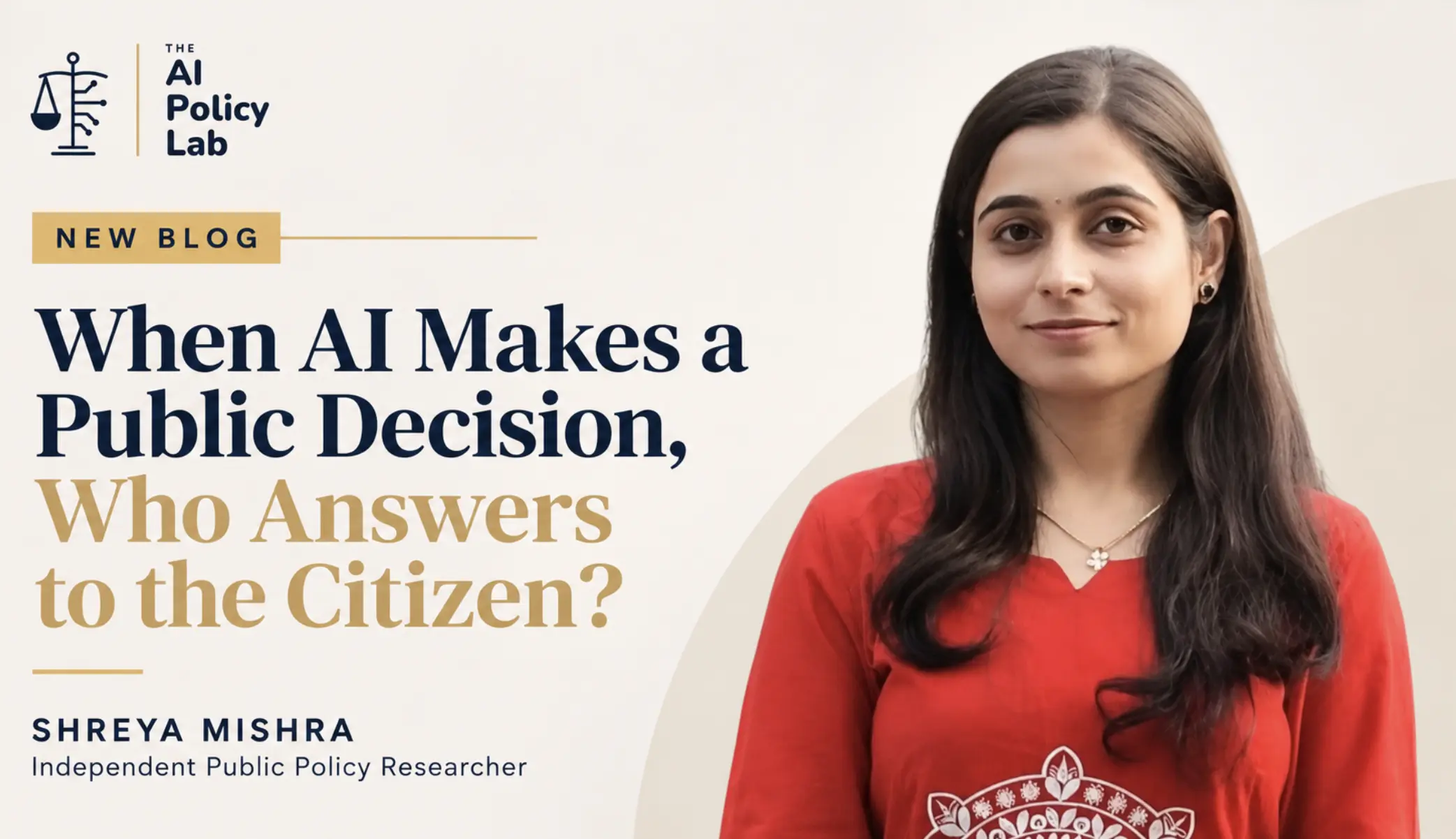
Artificial intelligence is increasingly becoming part of how governments deliver services, detect irregularities and make decisions. From identifying beneficiaries to processing applications and supporting public grievance systems, AI can make administration faster and more efficient. But when an AI-assisted decision affects a citizen’s access to a public service, the important question is not only whether the system is accurate. It is: who is responsible when something goes wrong?
India has already recognised this concern. NITI Aayog’s Approach Document for India: Part 1 – Principles for Responsible AI identifies safety and reliability, equality, inclusivity and non-discrimination, privacy and security, transparency, and accountability as important principles for responsible AI. The document also highlights the risk of citizens being unfairly excluded from essential services and government benefits because of incorrect AI-assisted decisions.
More recently, the Ministry of Electronics and Information Technology (MeitY) released the India AI Governance Guidelines in November 2025. These guidelines provide a national framework for the safe, inclusive and responsible adoption of AI. They emphasise a people-first approach, accountability, fairness and understandable AI systems. Together, these policy documents highlight the importance of ensuring that technological progress does not come at the expense of citizens’ rights.
Yet transparency alone is not enough.
Consider a citizen whose application for a government benefit is rejected because an automated system identifies the person as ineligible. If the citizen is simply told that “the system has made the decision,” an explanation alone does not provide a remedy. The citizen needs to know whether the decision can be challenged, who will review it, and how quickly an error can be corrected.
This is not merely a hypothetical concern. An investigation published in January 2024 by The Reporters’ Collective, in collaboration with Al Jazeera and the Pulitzer Center’s Artificial Intelligence Accountability Network, documented problems with Telangana’s Samagra Vedika system. The system used data from multiple government databases to assess individuals’ eligibility for welfare schemes. Errors in matching records led to genuine beneficiaries being wrongly identified as ineligible.
One reported case involved Bismillah Bee, a widow whose application for subsidised food was rejected after the system incorrectly associated her late husband with a vehicle owned by another person with a similar name. The case illustrates how errors in data matching can have serious consequences for people who depend on government assistance. It also demonstrates why citizens must have access to effective human review and a practical way to challenge incorrect decisions.
This is particularly important in public administration because government decisions can directly affect access to welfare, healthcare, education, identity documents and other essential services. An incorrect commercial recommendation may be inconvenient; an incorrect government decision can be much more consequential.
The solution should not be to prevent governments from using AI. Instead, India should strengthen safeguards for high-impact public-sector decisions. Where an automated or AI-assisted system can significantly affect an individual’s rights, benefits or access to essential services, citizens should have a clear and accessible route to request human review.
Such a system should have three basic features.
First, notice. Citizens should be informed when AI materially contributes to a decision affecting them. This does not require governments to disclose sensitive technical details or proprietary code. It simply means that people should not unknowingly be subjected to automated decision-making.
Second, a meaningful explanation. The explanation should be understandable to an ordinary citizen rather than written in technical language. People should be able to understand the main reasons for an adverse decision and identify the information they may need to correct or challenge it. An explanation is meaningful only when it helps a person understand what has happened and what they can do next.
Third, accessible human redressal. Citizens should be able to challenge an adverse decision without having to understand how an algorithm works. A designated public official or appropriate authority should be able to examine the relevant records, consider the citizen’s evidence and correct an error where necessary. The process should be accessible, timely and clearly communicated.
These safeguards would complement the broader principles of responsible AI outlined by NITI Aayog and the India AI Governance Guidelines issued by MeitY. However, policy principles alone do not automatically guarantee an effective appeal or review mechanism in every public service. Government departments must translate these principles into appropriate procedures, clearly assigned responsibilities and accessible grievance-redressal arrangements.
This approach would also strengthen public trust. AI should not become another layer of bureaucracy that citizens cannot question. The purpose of digital governance is to make public services more accessible and responsive, not to make government decisions harder to challenge.
India therefore, does not need to choose between innovation and accountability. It can pursue both. AI can assist public officials by identifying patterns and improving service delivery, while responsibility for consequential decisions remains traceable to the public institutions and officials responsible for their use.
The real test of responsible AI in government is not whether an algorithm can make a decision without human involvement. It is whether a citizen who is harmed by that decision can find a human being willing and able to examine the case, correct an error and provide an effective remedy.
If AI enters public administration, accountability must enter with it.
Discussion (0)
No comments yet. Be the first to start the discussion.