

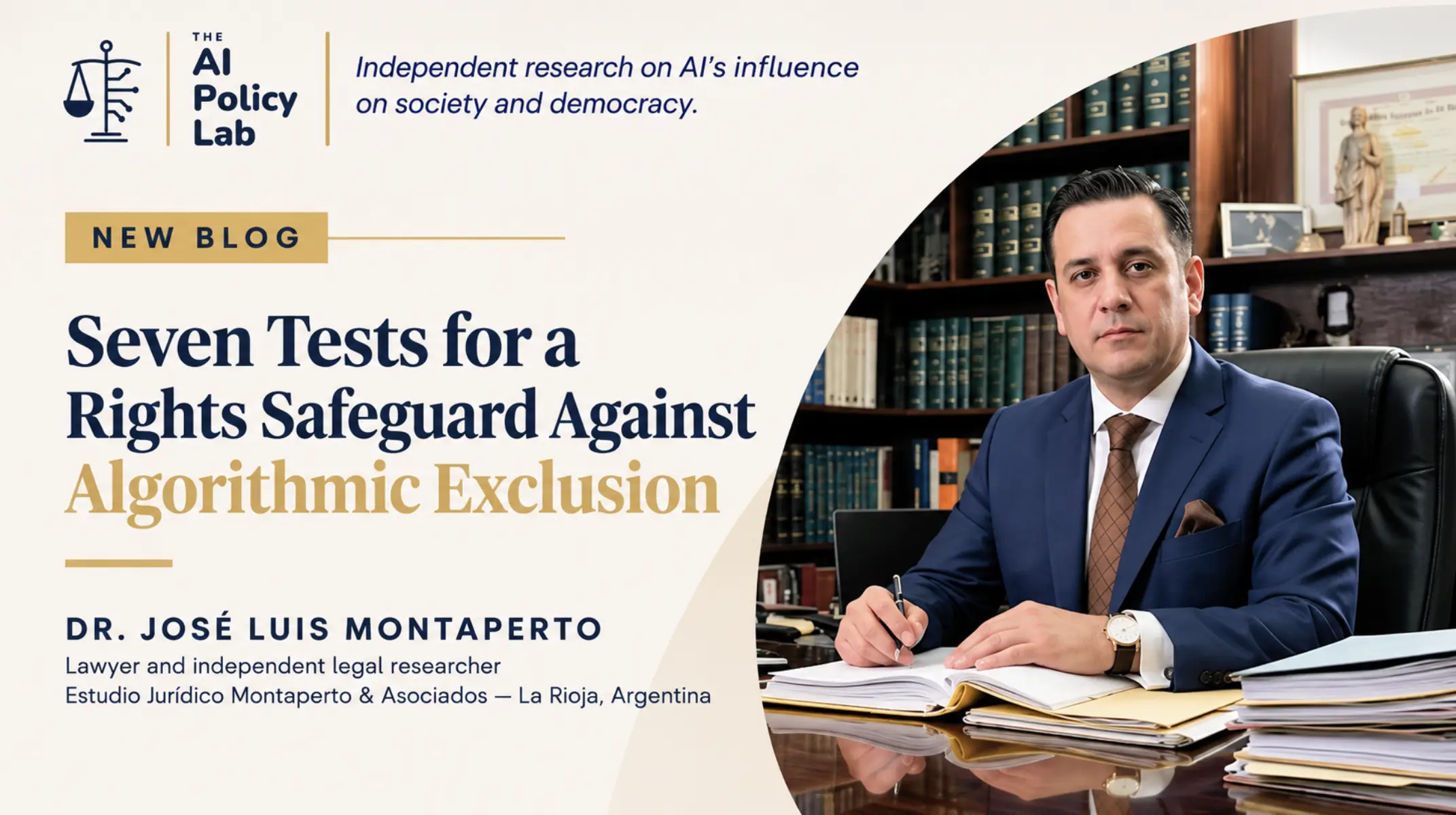
There is no freestanding human right to use artificial intelligence in the general international human rights instruments discussed here. The Universal Declaration of Human Rights protects equality, privacy, education, access to information and an effective remedy. The International Covenant on Civil and Political Rights protects, among other guarantees, equality before the law, privacy and an effective remedy in Articles 26, 17 and 2(3). These instruments do not require governments to provide every commercial model or guarantee unrestricted access to automated systems.
That qualification matters. Calling every useful technology a human right weakens legal precision and risks converting private products into unlimited public obligations. But the opposite mistake is just as serious: the absence of an autonomous right to AI must not obscure how algorithmic mediation can obstruct recognised rights.
A documented example is the SyRI judgment of the Hague District Court on 5 February 2020. SyRI was a Dutch government system for identifying risks of benefit and other fraud. The court held its legislative framework incompatible with Article 8 of the European Convention on Human Rights, stressing inadequate transparency and verifiability. This was a ruling about privacy safeguards, not proof that every flagged person had lost benefits. Its lesson for exclusion is practical: people need protection when opaque risk classifications can shape public intervention.
A future, technology-neutral safeguard should therefore be tested against seven questions.
- What is the underlying right?
A proposal should begin with an established legal interest—equality, privacy, due process, education, access to information or another recognised right—not with the technology itself.
- What concrete barrier does the system create?
The analysis should identify whether the obstacle is lack of access, inaccurate data, opacity, an inaccessible interface, absence of human review, or no effective way to challenge the result. SyRI makes opacity a concrete institutional issue rather than an abstract concern.
- Is access to the technology functionally necessary?
A right to a commercial product should not be inferred merely because it is convenient. The relevant question is whether a reasonable person can exercise the underlying right through an effective alternative channel.
- Is the proposed measure proportionate?
The response should match the barrier. Sometimes the solution is not access to a model but a clear explanation, data correction, assistance, or a human decision-maker.
- Is the rule technologically neutral?
A durable safeguard should protect capabilities—understanding, participation and contestability—without freezing a particular product or architecture into law.
- Who remains accountable?
Public authorities and private organisations should identify the humans and institutions responsible for deployment, supervision and remedies. Automation must not become a device for making responsibility disappear.
- What remedy follows?
A safeguard without a review channel is only a principle. The framework should specify correction, reconsideration, compensation, suspension or another effective response appropriate to the harm.
This approach also clarifies timing. The immediate priority should be to preserve existing guarantees: automation should not deprive people of an effective remedy or a non-discriminatory route to essential services. Where human review is proposed, its scope and legal basis must be specified rather than assumed to be universal. Broader commitments—literacy, infrastructure and public-interest access—may require progressive implementation and resource choices.
The aim is not to constitutionalise every AI service. It is to preserve human agency when algorithms become infrastructure. Law should protect the capacity to understand, use and challenge systems that shape the exercise of rights. The machine is not the rights-holder. The person confronting the machine is.
AI assistance disclosure
Claude and ChatGPT assisted with adaptation and source review; the author reviewed the final text and sources and accepts full responsibility. AI is not an author.
Discussion (0)
No comments yet. Be the first to start the discussion.