
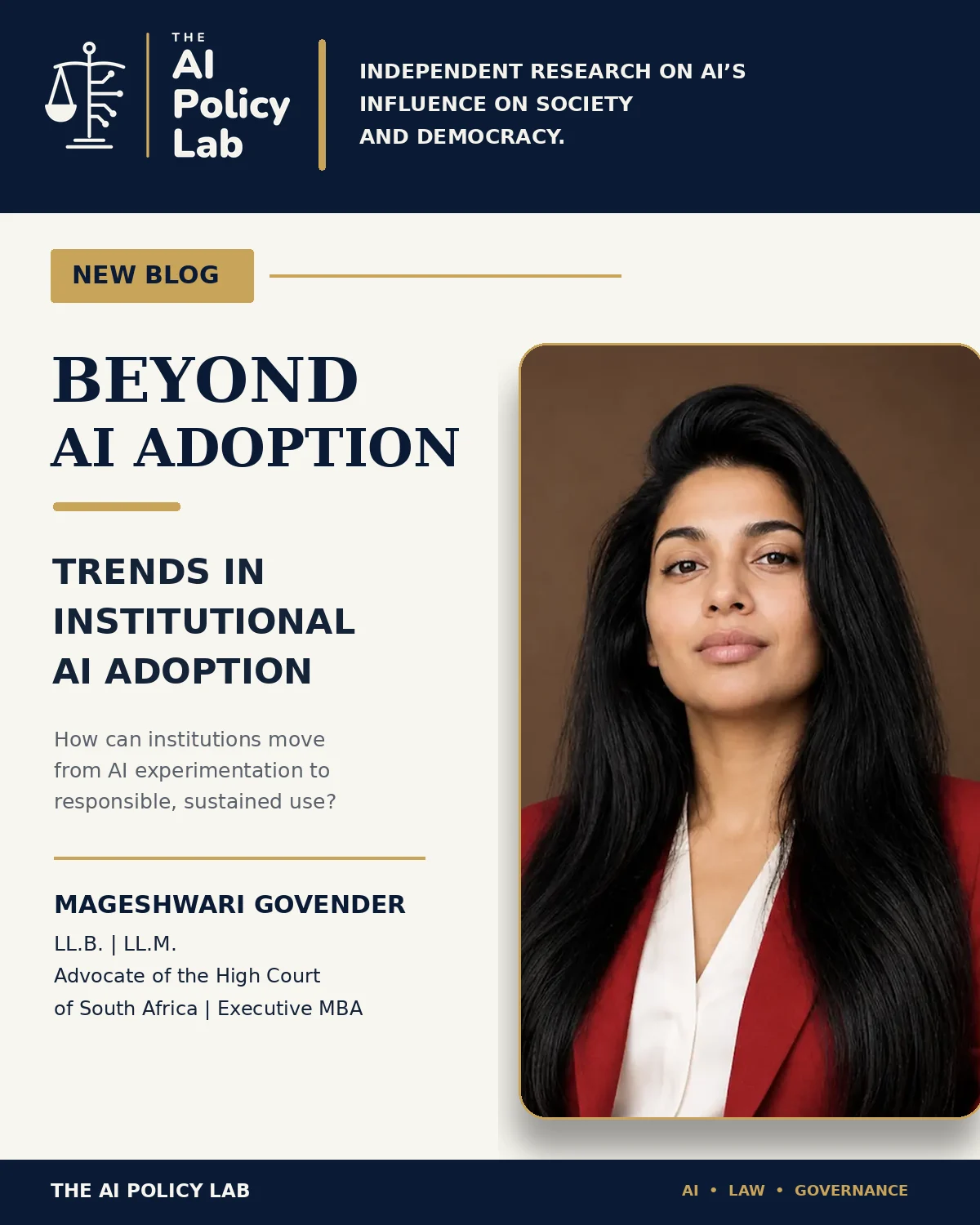
The global institutional conversation is moving beyond simply encouraging organisations to adopt AI. Attention is increasingly turning towards building the institutional, organisational and governance capabilities required to use it effectively and sustainably.
The factors informing this conversation challenge the assumption of a single global model. Governments, international organisations and businesses are approaching AI adoption from different perspectives, reflecting the differences in institutional mandates, resources, organisational structures and technological maturity. These differences raise a fundamental question: is institutional AI capability something an organisation builds by creating the right structures, or something it develops through the relationships, processes and learning that connect those structures?
Underpinning this question is a further institutional challenge: how do organisations manage uncertainty when the technologies they are seeking to adopt, and the environments in which they operate, are continually evolving?
Several recurring trends are emerging.
- AI adoption is increasingly associated with organisational transformation rather than technology implementation alone.
Organisations are recognising that introducing AI can affect workflows, decision-making, management structures and established operating models. McKinsey’s The State of AI: How Organizations Are Rewiring to Capture Value (2025) reflects this development, examining how organisations are restructuring their operations to derive value from AI. The implication is that technological deployment, without corresponding organisational change, may produce limited or fragmented benefits.
- Attention is moving from national AI strategies towards institutional implementation.
Governments have invested considerable effort in articulating national ambitions, identifying priority sectors and establishing policy frameworks. The challenge increasingly lies in translating these ambitions into institutional responsibilities, delivery mechanisms and operational capacity. The OECD’s Digital Government Outlook 2026 examines how governments are incorporating AI into public administration, while highlighting the organisational and institutional conditions that influence implementation.
- Institutions are reconsidering where AI expertise should reside within their organisational structures.
One approach is to establish centralised AI or data science units that concentrate technical expertise and provide organisation-wide support. Another is to embed specialists within operational departments, allowing expertise to develop closer to the functions and services in which AI will be used. A third approach combines central coordination with distributed expertise.
Selten and Klievink’s (2024) study, Organizing Public Sector AI Adoption: Navigating Between Separation and Integration, illustrates the advantages and limitations of these arrangements. Their findings suggest that centralised expertise can support technical depth and consistency, while embedded expertise can improve operational relevance. A hybrid approach offers the possibility of combining these advantages, although it also requires effective coordination, knowledge-sharing and clearly defined responsibilities. Neither organisational structure, in isolation, automatically ensures effective institutional adoption.
- The focus is shifting from experimentation towards sustained operational deployment.
Pilot projects and proofs of concept can demonstrate technical feasibility, but they do not necessarily establish that an institution can integrate, maintain or scale an AI application. The OECD’s Digital Government Outlook 2026 draws attention to the difficulty of moving beyond isolated initiatives towards meaningful, sustained use. This raises an important distinction between an institution’s ability to experiment with AI and its ability to incorporate it into established operations.
- Governance and risk management are becoming integral to adoption rather than considerations introduced after deployment.
Accountability, transparency, privacy, human oversight, safety and risk assessment increasingly shape decisions about whether and how AI systems should be used. The OECD’s Governing with Artificial Intelligence (2025) examines the governance arrangements required to support public-sector AI use. This suggests that institutional capability must encompass more than technical proficiency: it must also include the capacity to exercise oversight, allocate responsibility and respond to risks.
- Skills and institutional capacity are receiving greater attention as prerequisites for effective adoption.
Technical specialists are important, but institutions also need leadership understanding, AI literacy, domain knowledge and employees who can assess how AI affects their work. The OECD’s research on digital government highlights the importance of developing these capabilities across public institutions, rather than concentrating expertise exclusively within specialist teams.
- Adoption is increasingly understood as a continuous process.
AI systems, their capabilities and their applications continue to evolve. Institutional requirements, risks and operating environments may also change following implementation. Consequently, adoption cannot be treated as a decision that ends when a system is deployed. Ongoing monitoring, evaluation, institutional learning and the ability to adapt governance arrangements become essential. This is reflected in the OECD’s work on governing AI and the World Bank’s research on evolving national approaches to AI governance.
- Data, infrastructure and technological sovereignty are becoming central to the adoption debate.
Access to reliable data, computing resources, technical infrastructure and locally developed expertise influences which institutions and countries can meaningfully participate in the AI economy. Stanford University’s AI Index Report 2026 documents the growing importance of infrastructure, investment and national AI capabilities in shaping the global landscape. Adoption, therefore, is also connected to broader questions about institutional dependency, national capacity and control over critical technological resources.
- International approaches increasingly recognise that AI adoption cannot follow a single institutional model.
Different countries and organisations operate within different legal systems, resource constraints, institutional mandates and levels of technical maturity. The World Bank’s Global Trends in AI Governance: Evolving Country Approaches illustrates the diversity of national governance responses. This reinforces the importance of context-specific approaches rather than assuming that institutional arrangements developed in one setting can be transferred unchanged to another.
- Greater attention is being given to how adoption and institutional maturity are measured.
Counting AI systems deployed, pilot projects completed or employees trained may provide an indication of activity, but these measures do not necessarily establish whether an institution has developed the capacity to use AI responsibly and effectively. The OECD’s work on digital government and Stanford’s AI Index Report 2026 provide broader perspectives on the development and measurement of AI adoption. The emerging challenge is to assess not only the extent of use, but also the institutional foundations that make adoption sustainable.
Taken together, these developments indicate that the global conversation is moving beyond the simple question of AI adoption. Organisational transformation, institutional architecture, governance, skills, infrastructure, continuous learning and context-specific implementation are increasingly recognised as interconnected elements of the process.
However, an important question remains. If these are the capabilities institutions need to adopt and work with AI, how should those capabilities be organised, developed and sustained? More fundamentally, how can an institution determine whether it has the capacity to move beyond experimentation and isolated deployment towards meaningful, responsible and enduring use?
Discussion (0)
No comments yet. Be the first to start the discussion.