
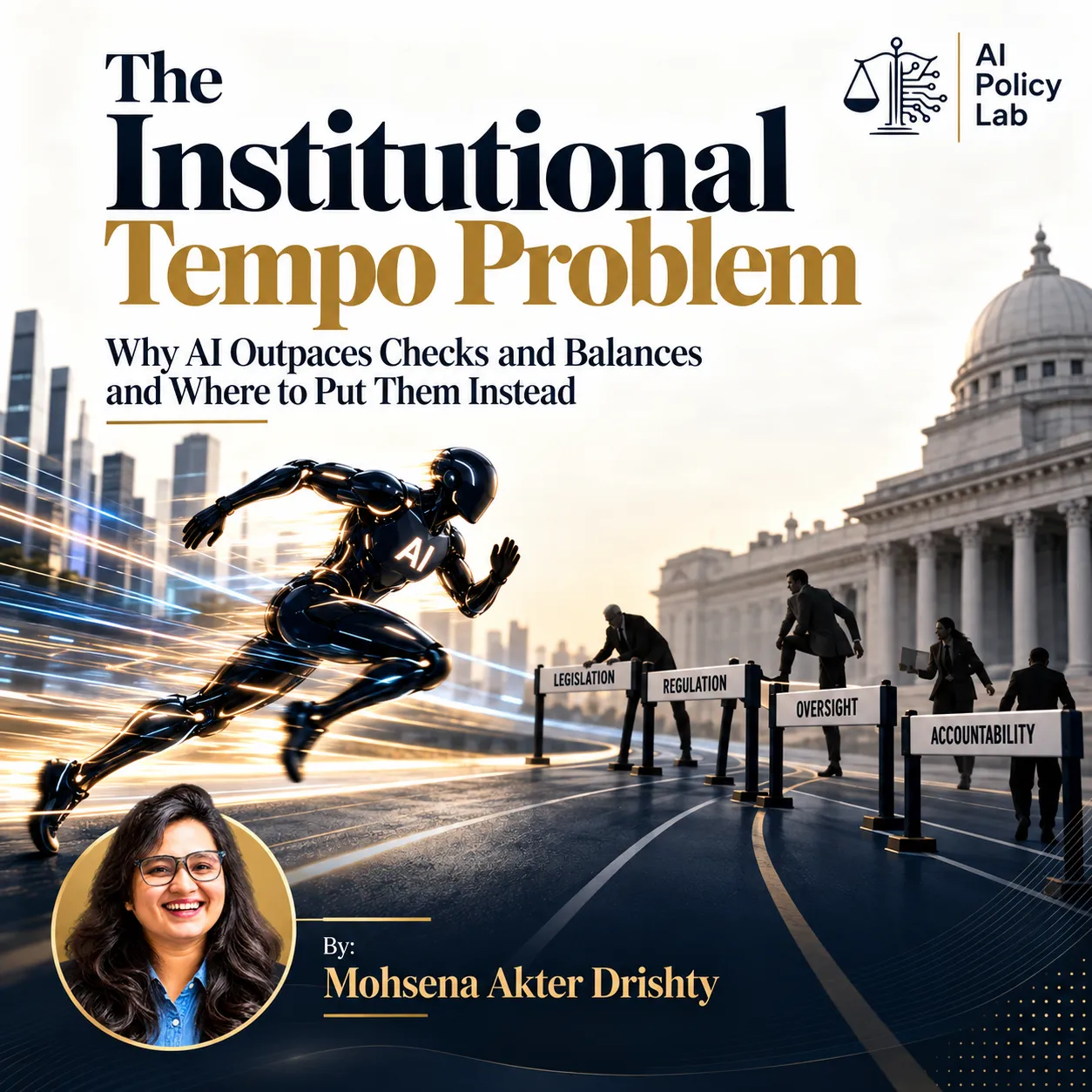
When the systems of checks and balances were designed, the goal was to prevent any single person, faction or institution from accumulating so much power that no other actor can constrain them. The solutions they arrived at were mechanisms such as separation of power, independent judiciary, electoral accountability and freedom of press. Those mechanisms were calibrated to human speeds. So, institutions have always had time to notice, deliberate and then respond.
However, the advancement of frontier AI is changing that scenario. The Stanford HAI AI Index 2026 reported that frontier models gained 30 percentage points on a leading expert benchmark in a single year. 35 of 36 OECD countries now use AI in at least one government function but only 12 report using AI to strengthen oversight and accountability. It is clear AI deployment is outpacing AI oversight in states with the most institutional capacity. This gap is structurally worse for states with less.
Rose Hadshar, a researcher at Forethought, argues that checks and balances evolved over centuries at human speeds and capability levels, may not naturally carry over to AI speeds and capability levels. Hadshar identifies three possible ways or a combination of them that could lead to extreme power concentration. First, active power grabs. An AI developer encodes system loyalties to entrench their own authority. Or a state uses AI-enabled military capacity to cancel elections and perpetuate rule. Second, economic displacement. As AI takes over valuable work, everyday workers lose their leverage. At the same time, governments begin relying on AI tech giants for revenue instead of citizen taxes, a dynamic Hadshar explicitly compares to the resource curse. Left unchecked, AI could soon replicate that dependency at scale. Third, epistemic disruption. The world changes faster than human cognition can track without AI intermediaries. It’s a breakdown in our ability to understand, verify, and agree upon reality. A large number of people now resort to general purpose LLMs to share their deepest secrets and verify their thoughts, ideas, and concerns. Imagine what will happen if those intermediaries are controlled by powerful actors to prevent the public from coordinating a response.
These dynamics can compound. Economic disempowerment weakens the capacity to resist. Strikes, protests or boycotts won’t have the same effect they do now. Alternatively, epistemic disruption, the constant change and confusion about your reality, will prevent you from recognising that resistance is needed. This leaves a massive power vacuum, making it incredibly easy for autocrats to seize total control.
This compounding structure exposes a significant oversight within current AI safety governance mechanisms. Procurement frameworks require auditability, regulatory bodies with independent investigative authority, and separation of oversight functions. These are effective to some extent. But they will fail once AI operates faster than human institutions can. For example, UK’s Department for Work and Pensions processed over three million Universal Credit claims through automated systems in 2022-23. Legal challenges to those decisions took months to years to resolve. That documented gap between decision speed and review speed is what the tempo problem looks like in practice, in a high-capacity state, today. It is structurally worse wherever technical regulatory capacity is thinner.
Relocating Checks and Balances
Instead of trying to make human institutions move as fast as AI, which might be impossible, we should change the rules so that the speed of AI is no longer an advantage. We can do this in three ways:
Instead of waiting for a human agency to find an AI problem after it happens, we should build tracking, automatic auditing, and emergency shut-offs directly into the AI code from the very start. This forces the system to check itself at machine speed.
We should mandate waiting periods and safety check-points before an AI system is allowed to launch.
A single country might not have the power to force giant tech companies to change their behavior. However, if many nations team up like the 55 member states of the African Union, they represent over a billion consumers. By refusing to buy AI unless it meets strict safety standards, they can collectively force tech giants to comply, similar to how developing nations teamed up in the past to get affordable medicine.
All three directions depend on a prior condition: independent technical literacy. Broad workforce data by the State of AI Literacy, shows that nearly half of professionals cannot explain basic AI mechanics and over a third lack functional safety practices. As public sector training initiatives absorb the majority of available resources, independent civil society organizations face severe talent shortages that hinder their ability to independently evaluate deployed technologies. This literacy gap is structural. Deployers have every incentive to build usage literacy because it drives adoption, and none to build contestation literacy because it invites scrutiny. Without it, every mechanism described here defaults to trusting the actors it was designed to check.
“Checks and balances do not need to be abandoned. They need to be relocated to where speed stops being an asset, and defended by populations who can tell when they have failed.”
For states that have always constrained more powerful actors with fewer tools, this problem has a familiar shape. What is new is only its speed.