
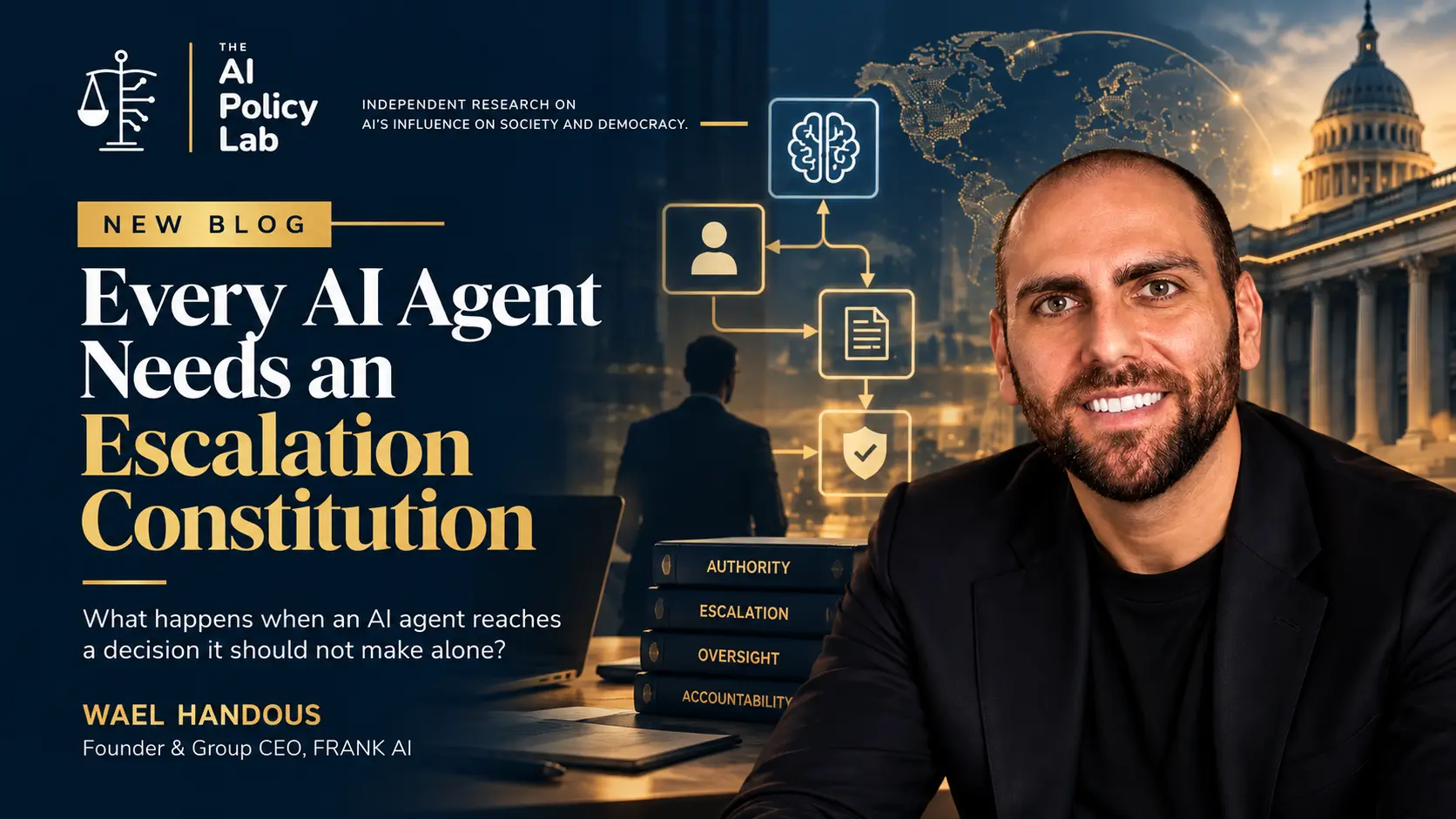
The hardest question in AI governance is not whether an organisation has principles. It is what happens when an AI agent reaches a decision it should not make alone.
Agents are moving beyond summarising and recommending. They can route customer cases, trigger workflows, rank leads, approve routine exceptions and influence operational priorities. That can create value, but it also changes the risk. A system that acts needs more than a policy document. It needs a clear operating constitution for escalation.
An escalation constitution is a short, practical agreement that defines four things before an agent is allowed to operate. First, it defines the decisions the agent may take without approval. Second, it identifies the conditions that require the agent to pause and hand control to a named human role. Third, it sets the evidence the system must retain so a decision can be reviewed later. Fourth, it gives people a real intervention path, including the ability to stop or limit the agent when its performance changes.
This is not a theoretical distinction. In a customer-service workflow, an agent may be able to classify a request, retrieve approved information and propose a response. It should not quietly decide a disputed refund, make a representation it cannot substantiate or override a complaint process. In real estate or other high-stakes commercial settings, it may surface comparable options or flag incomplete information. It should not make an unreviewed suitability judgement or conceal uncertainty from a client.
The boundary should be written in operational language, not in general promises to use AI responsibly. Teams need to specify the trigger: a low-confidence result, missing information, a request outside an approved category, a conflicting instruction, an unusual financial consequence or a protected decision. They also need to specify the owner: not simply “a human”, but the role that receives the handoff and the time within which it must be reviewed.
Evidence matters just as much. When an agent recommends or takes an action, an organisation should be able to reconstruct the decision. What information did the agent use? Which rule or model output mattered? What uncertainty was visible? Who approved, changed or rejected the outcome? What happened after that? A lightweight decision record will not make every system correct, but it makes failure visible and correctable.
The National Institute of Standards and Technology frames trustworthy AI around characteristics including accountability, transparency and explainability. Those ideas become meaningful only when they change the day-to-day operating model. The European Union’s AI Act similarly emphasises human oversight for relevant high-risk uses. Neither should be treated as a compliance slogan. The practical task is to translate oversight into a repeatable handoff process that works under real pressure.
Organisations should also set sunset conditions for authority. An agent’s permission to act should narrow or pause when the underlying environment changes: a new product, a new market, a drop in data quality, a sustained increase in exceptions or a material incident. Authority should be earned continuously, not granted once and forgotten.
The organisations that deploy AI well will not be those that promise perfect automation. They will be the ones that make responsibility legible. Before an agent acts, everyone involved should know what it may do, when it must stop, who takes over and what evidence remains. That is the escalation constitution.
AI use
Generative AI was used for research support and editorial refinement. Wael Handous reviewed the draft and retains responsibility for its argument and claims.